

Takeaways from Coaching with Linda
Linda’s clients’ takeaways from hundreds of career coaching sessions over 6 years.
Every prospective client has a similar question for me which is basically, “What will I get out of coaching with you?” Which is, of course, a very valid question considering the time and money they are ready to invest in working with the right coach.
I’ve had my career coaching business for over 14 years now and 6 years ago (after my business services has grown considerably from just offering resume reviews), I started asking clients what their biggest takeaway was at the end of every session.
Hundreds of sessions later, I’ve collected a tremendous amount of data! I used ChatGPT to summarize the main topics, which it did in a nice concise list and turned an hours-long project into a few keystrokes! Here are the results with my edits:
1. Coaching Relationship & Reflection
Having a coach as a mirror and accountability partner
Appreciating the structure, reflection, and space to talk things out
Realizing that they’re further along than they thought
Feeling cared for, seen, and understood in the process
2. Career Direction & Clarity
Aligning career decisions with values, strengths, and goals
Gaining focus and specificity in job goals and next steps
Narrowing down career options; identifying ideal roles or paths
Realizing there’s opportunity and hope; reassurance they’re not “stuck”
Seeing a clear, attainable future; confidence in making a career change
3. Strengths Awareness & Application
Using strengths to build confidence, direction, and intentionality
Deepening understanding of CliftonStrengths and how to apply them
Shifting mindset from weakness-fixing to leveraging strengths
Learning to articulate strengths authentically in resumes, interviews, and networking
Recognizing strengths like Harmony, Competition, or Context as assets
4. Confidence, Mindset & Emotional Growth
Overcoming Imposter Syndrome and negative self-talk
Building confidence in value, contributions, and compensation
Processing emotional baggage (e.g., anger, burnout, guilt, or loss)
Gaining validation and reassurance through coaching and structured reflection
Seeing progress and self-worth through wins, lists, and small achievements
5. Branding, Networking & Professional Presence
Developing their personal brand: strengths → brand → goals
Improving LinkedIn presence, profiles, and activity
Learning effective networking strategies (emails, informational interviews, follow-ups)
Understanding the power of conversation and connections
Using the CARLA framework to communicate stories clearly
6. Tools, Frameworks & Action Planning
Applying structured tools: CARLA, Career Factors, Career Progress Model, Holland/ONET, Strong Interest Inventory
Making tangible action plans, checklists, and weekly goals
Using platforms (LinkedIn, Google Docs, Idealist, etc.) effectively
Seeing career exploration as an ongoing process, not a single decision
7. Resume, Cover Letter & Interview Skills
Doing detailed, line-by-line resume work (structure, verbs, quantification, formatting)
Learning to tailor materials to job descriptions
Writing compelling cover letters and professional summaries
Doing interview preparation: organizing answers, thinking on feet, closing well
Seeing resumes and interviews as storytelling, not self-judgment
—-
If one or more of these seem helpful to you, reach out now!

How Do I Know Coaching Is Working for Me?
Wondering if you should continue to do coaching? Here are some indicators that your investment of time, money, and energy are well worth it.
I’ve been asked different versions of the question “How do I know if coaching is effective?” This is a very good question because it means you’re being very intentional and conscientious about the coaching process.
I can’t answer your question but you can! Here are some good indicators that the time, money, and effort you’re putting into coaching is worth it.
You feel less anxious, depressed, hopeless, or stuck. The negative feelings you couldn’t shake before you started coaching are no longer hanging over you and dragging you down. Even if they haven’t completely disappeared, you feel noticeably relieved of them.
You feel more hopeful, motivated, calm, or inspired. You’re seeing the light at the end of your career tunnel. You actually feel lighter, more energetic. You’re smiling more. You’re starting to look forward to the future again.
You are accomplishing new and hard things you weren’t able to do on your own. Those things you knew you were supposed to be doing but just couldn’t get yourself to do (ahem, reaching out to old colleagues, updating your LinkedIn…) don’t seem as overwhelming. You actually have a clear plan to move ahead and are tackling things you couldn’t get yourself to do before!
You are learning new things about yourself and/or the workplace. You’re discovering your deeper motivations, talents you took for granted, emotional barriers hindering you, or other insights unveiled by your coach’s thoughtful questions and expert listening skills.
You look forward to your coaching sessions. You’ve built good rapport with your coach and are enjoying the conversations because of the reasons listed above.
You feel like each session is a good use of your time and money (you don’t feel like it’s wasteful). You don’t regret your sessions!
I’m not saying coaching will solve all your problems. Nor should you expect to experience all these indicators after the first session. But it should definitely help you get much closer to a solution than you can on your own.

5 Ways to be a Successful Coaching Client
If you’re new to coaching and not sure how to make the most of it, I lay it out here in 5 simple tips.
So you’re new to coaching! It’s like therapy in that you schedule sessions to talk with a professional 1:1 (see blog post “What is Coaching vs. Counseling vs. Consulting”) but with me, you’d work specifically on reaching career goals.
Many of my [potential] clients start coaching hopeful but not sure how to make the most of it. This blog post will lay out the characteristics of my most successful clients so you can be successful too.
First of all, here are the basics of my coaching sessions:
60 minutes each
Online video calls (via Google Meet)
Every 1-3 weeks
Homework after every session
$200 per session in a package ($250 for single sessions)
As a career coach, I have dedicated hundreds of hours and thousands of dollars to becoming highly skilled in my profession because I really enjoy helping people navigate career processes and reach their goals. But I can only do so much.
As a client, you get as much as you put in. So here’s what I recommend you put in:
BE OPEN AND HONEST: I’m not here to judge or shame you in your career frustrations or lack of success, so tell me everything! From the very first coaching fit call (Contact me to schedule a free 15-minute phone call to assess whether we’d be a good coach/client fit), it really helps me to know not just what you want to achieve but also your feelings around it, things you’ve tried that didn’t work, personal relationship factors, etc. Clients who are open and honest will allow me to help them better navigate all the important factors in achieving their career goals.
COMMIT TO THE PROCESS: The main reason I offer packages of sessions and make them cheaper per session than single sessions “à la carte” style is because I want to help clients follow through in the process of either career exploration, career transition, or career change. (see blog post “Career Change vs. Career Transition, and How a Career Coach Can Help” and my Services page for the different packages I offer) In the past when I only offered individual sessions, many clients would have a great 1 or 2 sessions then drop off, which is really a waste of their time and money because they didn’t progress enough to accomplish anything. Requiring my clients to pay for multiple sessions upfront helps hold clients accountable to themselves to make the improvements they want in their career. Clients who commit to the process have a much higher chance of accomplishing their career goals.
COMPLETE YOUR HOMEWORK: Every session ends with the client agreeing to some kind of homework to complete before the next session, whether it be introspective writing, researching something, and/or reaching out to certain people for networking. This work between sessions is to help clients deepen their work and further their progress in the process without the ticking clock of our hourlong sessions. They can think and do it on their own time. If clients don’t complete all their homework by the next session, I don’t shame or lecture. Instead, I ask them non-judgmentally what barriers got in the way and help them plan to be more successful next time. Clients who complete their homework will progress much faster in reaching career goals.
KEEP UP REGULARLY SCHEDULED SESSIONS: I generally recommend we meet every 2 weeks - enough time to get homework done but not too long that they’ll lose momentum. I offer a lot of flexibility when clients need to reschedule when needed (with at least a day’s notice). Clients who keep up regularly scheduled sessions will progress better in reaching their goals because they won’t forget and have to redo the work they’ve already done.
TRY NEW THINGS: I believe that “life begins at the end of your comfort zone” and no growth is comfortable. So if you’re seeking coaching, you’re telling me that you’re ready and willing to commit to the process of growth in order to improve your career. I’ll likely suggest doing new things that may feel uncomfortable (like reaching out to strangers!) or help you do things you know you should do but haven’t yet (like updating your LinkedIn profile). Clients who are willing to try new things will grow in rewarding ways that will get them closer to their career goals faster.
There you have it. Coaching is a journey we take together as coach and client. I’m ready and excited to help you be successful. Come join me!

A Process for Personal Branding
Personal branding can be overwhelming and confusing. I’ve created a clear process and unique framework to help you articulate who you are and what you have to offer to your target audiences with confidence and effectiveness.
You may already have an inkling of the importance of personal branding - everyone’s telling you to do it. There are endless articles and books proclaiming its value and giving vague, disconnected advice and random tips (I’ve read many of them) that leave many people confused and overwhelmed about how to put it all together.
But what is personal branding anyway? Here’s my definition:
A concise, compelling way of communicating who you are and what you have to offer to your target audiences.
Ok, but why is it so important?
You already have a brand. You always have and always will.
Your brand is like your hair or nails. If you don’t manage your brand, it will become unruly, distracting, or hindering to your goals.
Having a well-managed brand will help you feel more confident and be more successful.
If you want to be taken seriously as a professional and be successful in your chosen career path, intentionally designing and managing your personal brand is not optional - it’s crucial.
But many people have no idea where to start because how do you pack a lifetime of unique experiences, skills, decisions, interests, and accomplishments into a neat little package with a bow on top? How do you know when you’re done? How do you know it’s effective?
I got you!
As a career coach, I’ve been developing and teaching my unique framework and process for personal branding for 7 years now. I’ve taught it to thousands of students at universities and professionals at conferences/webinars/panels around the country. What’s more, I regularly re-evaluate and update my framework according to client feedback and real world developments, like the need to communicate your brand effectively through the recorded video interviews that have become common in the past few years.
I created a clear structure around the ambiguous, nebulous, chaotic thing that is personal branding so you can have sequential steps to communicate your personal brand and achieve your career goals. It looks something like this, with each box filled in, of course.

Personal branding is often time-consuming hard work. I’ve created a road map and I have a package of sessions and worksheet to walk you through the process using my highly evolved framework. Each stage of my framework has exercises to help you articulate and rehearse different aspects of your personal brand so you can convey your brand in a confident and compelling way.
There’s no shortcut to digging deep to understand who you are and what you have to offer, who your target audience is and what they want, and how to be communicate with them. Those who put in the work will see real results.
Contact me if you’re ready to start your personal branding journey!
See my articles, podcast interviews, and webinars on personal branding.

Career Change vs. Career Transition, and How a Career Coach Can Help
What’s the difference between a career change and a career transition? This post lists the differences and how a career coach can help you navigate your situation with clarity and confidence.
Change is stressful whether it is intentional or forced upon you. In your career, you will go through many changes.
“There is nothing permanent except change.” ~Heraclitus
Some you will gladly choose and plan for, some that will be completely unexpected and unwanted. “Career change” and “career transition” are often used interchangeably but they are not the same. To help you have more clarity in adapting to, coping with, and planning for change, I’ve listed the differences below:
Career Change
Intentionally changing job -
Function - set of responsibilities/tasks
Industry - type of business services/goods
Function & industry
A career coach can help you decide what you really want and create an action plan to rebrand yourself for a successful career change.
Career Transition
Keeping the same kind of job but transitioning out of want or need from -
One job to another (same function & industry)
One location to another (same company)
One supervisor/team to another
One organization structure to another
Working for an organization to working for yourself (or vice versa)
Working part-time to working full-time (or vice versa)
Working remotely to working onsite (or vice versa)
Working a job to retirement (or vice versa)
Working full-time to being laid off
Studying in a full-time graduate program to working full-time
Not working full-time to re-entering the workforce
A career coach can help you cope with the mix of emotions, evaluate your expectations, align your life with your values and priorities, manage the impact on your lifestyle and relationships, and adjust your mindset and behaviors for a successful career transition.
—
Whichever kind of change you’re going through, working with a career coach can provide the organization and confidence you need to move forward. I am primarily a Career Coach but I also have training and experience in counseling and consulting to help clients with career changes and career transitions. Check out my services if you’d like my help.

What is Coaching vs. Counseling vs. Consulting?
What are the differences between a coach, a counselor, and a consultant? And which one do I need? I do all 3 and this article clarifies them!
You may have wondered, “What’s the difference between a career counselor and career coach?” Some people have mistakenly called Launched by Linda a consulting business, when I’m primarily a coach. I’ve also been called a career counselor when I don’t have the legal license for it.
So I’m here to clear it all up!
I’m a Career Coach who utilizes all 3 approaches according to each clients’ needs. There are many ways to define and differentiate between coaching, counseling, and consulting but for the purposes of my services, it can all be summed up in this simple table.

Coaching is all about clarifying your goals then creating an action plan to achieve them as well as an accountability system to follow through.
I use coaching when a client doesn’t know what they really want or how to get it it.
Coaches believe clients have the answers within themselves and it’s our job to facilitate the process to help them discover insights through strategic questions, so we don’t give advice.
I received extensive coaching training through a certificate at New York University and strengths coaching certification program at Gallup.
Counseling is mainly about working through difficult emotions and gaining self-awareness about motives/causes in order to achieve mental peace to move forward.
I use counseling when a client seems stuck on certain emotional or relationships barriers such as guilt, shame, fear, grief, anger, etc.
Counselors help you make meaning out of unresolved experiences and cope with uncomfortable situations.
I received a master’s degree in Psychological Counseling from Columbia University.
Consulting is a focused approach of giving specific advice to solve specific problems with proven experience and expertise.
I use consulting when a client simply does not know how to do something (i.e. tailor their resume, maximize their LinkedIn profile, write an effective college essay) and simply need to learn new skills.
Consultants have accumulated a vast amount of knowledge and best practices through constant professional development and actual practice.
I have been offering career services through Launched by Linda since 2011 and am an active member of the National Career Development Association.

10 Networking Mistakes and What To Do Instead
Why is networking so hard? You might be doing it wrong. Read about what to do instead to maximize the benefits of networking.
In the world of digitized job searching, networking is still of utmost importance - both in person and online. Job seekers who want to stick with doing it "the old-fashioned, honest way" by trying to apply for jobs without interacting with other humans are going to get a lot more frustrated and discouraged. Here's why:
Quick and easy one-click applying makes it easier for job seekers to apply to many jobs in a short period of time, but it creates a lot more work for employers to find the best fit. Candidates get drawn into the illusion of efficient job searching (i.e. "I applied to 100 jobs today! I don't know why I'm not getting any interviews!") while employers are faced with the task of sifting out many more irrelevant, under-qualified, or overgeneralized applications. Quantity doesn't equal quality, for either side. Plus ATS (applicant tracking systems) may weed out your resume before it even reaches a person.
Networking with real live humans seems slower and less attractive to job seekers because it's unpredictable and ambiguous, but it is so much more effective because employers are more likely to consider candidates they know, or who are known by someone they know and trust.
Most people I know dread networking and it’s not necessarily because they’re shy. I think it's because they have faulty assumptions about effective networking. Maybe you already know networking is important and necessary, but you're frustrated and confused why it isn't yielding results.
First of all, the very definition of networking is often misconstrued to be dirty and dishonest - "getting in through the back door." There is a clear difference between networking and nepotism. Try this on for size -
Networking (verb): To develop relationships of mutual benefit and interest.
Next, there are many factors in play, but make sure you're not doing any of these things:
Only asking for a job - This doesn't work for multiple reasons. Unless they have direct hiring power, they can't give you a job. If it's a new person you're talking to, why would they want to do you a favor while putting their reputation on the line? They don't know your skills, work ethic, or moral character so if they were to recommend you to their boss (which doesn't guarantee you a job anyway) and you turn out to be a poor fit, their boss’ trust in them is compromised.
INSTEAD - Ask for insights about the organization, advice for getting an interview, opinions about the leadership...any knowledge to give you an advantage in your job application process.
Only asking people you know directly - These are considered your "strong ties" - people with whom you are familiar and likely know similar information and resources. They are too close to what you already know and, despite good intentions, are less likely to give you new information or leads.
INSTEAD - Pursue your "weak ties," the people you met once and/or haven't talked to in years. Give a casual re-intro like, "Hey Bill! It's been a while! I see you're still working at ___. I'm looking for a new job and was wondering if you could tell me about your experience in the finance department?"
Only thinking of being a taker - Networking often feels dirty because it seems like you're just asking for favors. Please see the definition above...it should be mutually beneficial and interesting! You may think "What do I have to offer?" Well, it won't be a quid pro quo of equal exchanges.
INSTEAD - Offer genuine admiration and curiosity by asking about their life and advice, and offering relevant resources. Anything from restaurant recommendations to insightful articles to well wishes for their next vacation will help strengthen the relationship.
Thinking you have to love it to do it - As adults, we have to do many things that are unpleasant but necessary, like washing dishes and filing taxes. Networking is really no different. Don’t wait until you “feel like it” because you may never naturally want to.
INSTEAD - Set aside a time to do it regularly and find external systems of accountability if you just can’t motivate yourself to do it. Schedule it in your calendar, set up noise reminders, give yourself a reward, find an accountability buddy, or hire a coach.
Thinking extroverts are naturally better at networking - Extroverts may have less anxiety about meeting new people and enjoy it more than introverts, but effective networking comes down to building authentic rapport, which introverts can do just as well.
INSTEAD - Create genuine connections with whomever you reach out to, regardless of your personality type. If it’s the “cold calls/emails” that you dread, ask people you already know to introduce you.
Using the same scripted elevator pitch for everyone - No one likes receiving a generic sales pitch. If you don’t take the time to write an individualized message for someone whose time/expertise/attention you’re trying to get a hold of, why should they give you their precious limited resources?
INSTEAD - Craft a thoughtful message for each person that is clearly meant for them. People are much likelier to respond if you do some research first and know you’re not just broadly spamming strangers.
Thinking you’ve never done networking before - I guarantee you’ve been doing some kind of networking in your life. You just may not have thought of it as such because it wasn’t about the nerve-wracking, high-stakes process of job searching. None of us are an island; we all depend on others for our survival and growth.
INSTEAD - Think of it as practicing a new skill to benefit your professional future. You may never actually love it but the more you do it, the more comfortable you will become and the higher your chances of benefiting from it.
Giving up after not getting responses from everyone - People have different priorities and you will never get a 100% response rate no matter how good your messages are. Don’t take silence personally. Don’t expect to hear back from everyone you reach out to and be grateful for everyone who does respond, even if' it’s not directly helpful.
INSTEAD - Try to look for commonalities between the people who do respond in a helpful way and tailor your approach accordingly.
Thinking it’s a one-time conversation - Relationships aren’t built on a single conversation, although not every conversation needs to lead to a long-term friendship. Networking is a process that takes time to bear fruit and should not be done only for the few months you are job searching.
INSTEAD - Try to make networking a lifestyle by reaching out to your contacts periodically with updates about your life and inquiries on their life. There are helpful tools like scheduled emails so you can write them now to be sent out later.
Saying you’re open to anything (being vague) - People can’t help you if you are not specific about what you want/need because your request will quickly be forgotten. They don’t have the time/energy/interest to dig for your professional values and priorities; that should all be self-work that you’ve done before asking for help.
INSTEAD - Be very specific in saying what you are looking for and what you’d like their help with. If they say they do have a lead, make sure to follow up with them in a few weeks if you haven’t heard back.
—
Can you get a job without networking? Technically, yes. Of course. Some people are lucky and have people coming to them with interview invitations and job offers. But for most people, getting good jobs they would want requires an investment of intentionally developing relationships of mutual benefit and interest.

Career Advice for Anxious Parents of Teens and Young Adults
Are you stressed about helping your teenage child prepare for their future career? Worried you’re not doing enough to help them make a decision and focus their studies? I wrote this article for you.
Dear parents,
Are you stressed about helping your teenage child prepare for their future career? Worried you’re not doing enough to help them make a decision and focus their studies? Thinking about hiring me to get your teen on track to a lucrative, surefire career path?
I wrote this article for you.
I’ve been working with teens - and parents of teens - in career preparation for a decade. Throughout my 10 years working at 5 universities, I’ve worked as career counselor, administrative staff, instructor, and admissions reader. I’ve helped students edit essays and practice for interviews to get admitted into college, graduate school, and professional schools (dental, medical, law, business) as well as obtain internships and jobs. I studied career counseling in my master’s program.
I genuinely love and care about teens and young adults. They are at a very special stage of their lives full of growth and potential but also often immense pressure and debilitating anxiety. Some of the negative emotions come from schools and peers, but a lot can come from parents. Parents’ anxieties can come from schools and their peers as well!
If you’re reading this, I will assume that you are a parent with pure intentions for your child’s contentment and fulfillment by choosing a career path that best fits their interests and abilities, NOT a parent who is trying to push your child into a career choice based solely on maximizing prestige and wealth to make yourself look and feel good. If you find that you fit more into the latter group, my blog post will not align with your values.
My goal in writing this is to help lighten your anxiety by presenting facts and observations from my experience as a career coach to share a healthier perspective towards career development while helping you improve your relationship with your child and actually increase their preparation to choose a fitting career for themselves.
My main point is basically this:
You do not need to push your child into a career path decision right now.
Consider this…
There are various personal factors to choosing a suitable career path - interests, strengths, values, personality, etc. All of these are still in the development stages throughout adolescence and into their mid-20s. Trying to pin them down too early, like in STEM or the arts, could stunt their development and exploration.
The workplace is changing at the fastest pace in world history and it’s better to be adaptable and well-rounded than highly specialized, especially at a young age. A minority of youth will have a strong determination to enter a highly specialized field, in which case it would be beneficial to start gaining knowledge, skills, and experience right away, but most teens are still uncertain.
Many job titles that people hold today didn’t exist when they were younger. Some people’s “dream jobs” may not have been created yet. Some jobs will become obsolete in a few years as technology and the world economy changes.
Youth - and sometimes their parents - have very limited knowledge of career options, both due to limited exposure to the world and their lack of interest because it is not immediately relevant to their current lives. Neither you nor your child may be aware of the best career option yet.
The average person will change jobs many times over their lifetime career. It’s okay to start out with something that is not a “perfect fit” as they are gaining experience and skills.
Career advice and norms that worked for your generation or your parents’ generation may be irrelevant or even harmful to your child’s generation. For example, it is now increasingly unlikely that someone will graduate from college and stay in the same job until retirement, so becoming complacent in their first job out of college without actively managing their career would leave them vulnerable if unexpected lay-offs happen.
Most professions have many roads that can lead to it.
All jobs require a range of soft and hard skills. Specialized technical training and versatile interpersonal skills are equally important in all jobs, so youth should be developing both.
Most people would do well in more than one type of job.
My advice
DO foster your child’s curiosity and exploration of their interests through classes, extracurriculars, hobbies, and volunteering. Encourage an open mind to learn about new and unfamiliar things. Help them become aware of issues in the world and observe where their natural passions lie because genuine interest is the best motivator to gain knowledge and build skills.
DO motivate them to maintain good grades in all their classes because that opens up opportunities in the future to get into the college of their choice (if they choose to go to college) and be more competitive for scholarships.
DO encourage your child to engage in self-reflection to increase self-awareness through conversation, artistic expression, and/or journaling. What did they like/dislike about an activity or experience, and why? How did they feel about themselves afterwards? What do they feel motivated to do about it?
DO teach your child to talk to or shadow (with your supervision as needed) people whose professions they’re interested in. Help them build healthy relationships with mentors. If that is not possible for whatever reason, help them look up “day in the life of [profession]” on Youtube and watch the realities of those professions to decide if they want to pursue them further.
DO help your child become aware of their natural abilities and talents, then take opportunities to improve upon them both in school and outside of school. Skills mastery builds confidence and self-efficacy to learn anything in the future.
DO celebrate their uniqueness and find contexts where they are rewarded for who they naturally are. The best-fitting career paths are chosen to match who we already are, not ones that require us to change or hide who we are. For example, if they are very introverted, help them explore careers that are more behind the scenes and allow for more quiet time to work alone.
DO inspire your child to look to role models in history, fiction, or real life. What do they admire about them and why? How do they want to emulate them? (Of course, no role model is perfect so be sure to point out that not all parts of a person are worth emulating.)
—
DO NOT compare your child’s development or decisions to others, especially to make them feel inferior.
DO NOT internalize your child’s career decisiveness as a reflection of your success or love as a parent.
DO NOT try to narrow your child’s career path before college. If your child’s school is forcing them to choose a certain focus or concentration, let your child choose which one sounds more interesting to learn about, not which one will lead to the most impressive or high-paying job.
Helpful frameworks
Career coaches and counselors like myself tend to love theoretical frameworks because they help provide clarity and structure to what often feels like a messy, ambiguous process. Here are a few I find particularly helpful for teens and young adults:
CliftonStrengths was created by psychologist Don Clifton who proved that people are more engaged, confident, happy, and successful if they focus on developing their strengths instead of trying to fix their weaknesses. He wrote books and developed an assessment (including a youth version for ages 10-14) to help people identify their top natural talents and find ways to intentionally utilize them in their goals and challenges. I am a Certified Strengths Coach and offer coaching to help people better internalize and apply their strengths.
The Challenge Mindset was created by career consultant JP Michel who designed a new way of helping students choose their career path. Instead of using the traditional filters of job titles or majors, he created a set of cards to help youth see the world through interesting challenges to tackle and then figuring out what role they want to play in it.
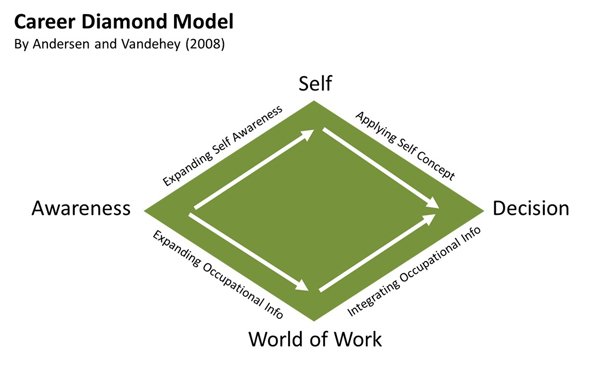
Career Diamond Model was created by counseling professor Patricia Andersen to capture the career decision process in a simple graphic representing the integration of personal and external knowledge from awareness to decision (not extending to the action steps of carrying out the decision). Teens and many young adults must go through the expansive stage of gathering information about themselves and the world of work before narrowing their options and making a final choice. This process is usually repeated throughout a person’s life as internal and external factors change.
My personal example
I have lived, observed, and taught all the principles above. Here’s a glimpse of how they worked out in my life:
I had many career ideas growing up: paleontologist, beautician, dermatologist, personal trainer, jazz singer, food taster, nutritionist, motivational speaker, movie critic, high school history teacher…I eliminated all of them as I considered my abilities and values through the years.
I chose all my high school and college classes based on pure interest without any strong direction towards a viable career. I resisted all parental pressure to take college classes in high school to get through college faster, or choose traditionally prestigious and high-paying jobs like engineer or lawyer. I majored in American Studies because I love U.S. history and spent most of my time/money/focus on my minor in Ballroom Dance because I knew I’d never have those learning and performing opportunities after college. I don’t use either of those subjects in my professional career but they have greatly enriched my life by expanding my intellect, network, skill sets, and work ethic.
I discovered my current passion for career coaching through happenstance during my last year in college through my interest in volunteering on campus and then my need for a summer job as a mentor/counselor for younger college students. It took me 5 years of trial and error to get my first full-time dream job after graduation.
I’d never heard of a blog, podcast, webinar, or professional conference in high school but I’ve written/spoken for dozens of them since then. I never imagined having my own coaching business, but I’ve had one for 12 years now. Nobody - neither my parents, teachers, advisors nor myself - could have predicted or prescribed this career path for me. But by following the advice above which I learned along the way, I have been very successful and satisfied with my rewarding career choice. I hope to help many more people create a meaningful career and life. And there may be additional exciting jobs and roles I discover in the future!
What I can offer…
Therefore, I will not steer your child into any certain career path before college, but I am happy to offer these services for teens and young adults:
Strengths coaching to help them identify, internalize, and utilize their natural talents.
Essay editing to increase their chances of being accepted by the school, program, or scholarship of their choice.
Interview preparation to help them confidently articulate who they are and what they have to offer in a job, internship, or graduate program.
Resume/LinkedIn review to best demonstrate their experience and skills in writing for school or job applications and networking.

CARLA: A Better Framework for Answering Interview Questions
Anxious about upcoming interviews? Using my proven framework to prepare will help you feel calm and confident to get the job offer you want.
Upcoming job interviews frequently spike candidates' anxiety levels.
For years as a career coach, I've taught clients the STAR method to structure their answers to behavioral questions.
S - Situation
T - Task
A - Action
R - Result
Behavioral questions usually start with words like, "Tell me about a time you [performed a specific competency or task]." Or, "Can you describe a time when you [responded in a certain way to a specific situation]." Interviewers ask these kinds of questions with the assumption that learning about your past behavior will help them predict your future behavior on the job.
The STAR method does a great job of framing career highlights, but as I spoke with more recruiters and hiring managers, I sensed that it wasn't enough. It served behavioral stories on a platter to interviewers, but still leaves some work for them to connect the candidate's response to the job as they consider many factors in choosing the best person to hire.
The hiring process can be stressful for employers as they are for job seekers, albeit with somewhat lower stakes. Anytime job seekers can remove friction and simplify the process for employers gives them a greater advantage against the competition.
So I decided to create a new acronym to help job seekers prepare even more helpful answers to employers' behavioral questions that will hopefully make their candidacy more compelling by doing the work of explaining why their previous experience and behaviors are directly relevant and beneficial to the vacant job. I introduce to you - CARLA.

You'll notice that the "A" and "R" represent the same parts as the STAR method, but here are the differences:
"Context" replaces "Situation" and "Task" to allow candidates to describe moments of personal initiative. "Task" seems to imply that a person needs to be given an order or external directive to do something, thus hinting passivity. Sometimes the candidate's greatest shining moments are when they noticed something that could be improved or a problem that can be prevented, so they jump to action before being told what to do. "Context" is more neutral and simply allows the candidate to describe the scene before they took "Action".
After the "Action" and "Result" (problem solved), the "Lesson" prompts the candidate to describe what they have learned and how they have improved from the experience. This displays to the interviewer that not only have they fixed something that needed attention, they also became a better professional and person from it!
"Application" is where the candidate connects the dots for the interviewer by describing how the knowledge and skills they gained from the experience will become immediately useful to the job they're vying for. Not only does this extra step give the interviewer's brain a sigh of relief from having to perform that step themselves, it also demonstrates the candidate's deep understanding of the job requirements based on their research and deep listening skills.
The STAR method focuses on your past but employers are more interested in your potential future with their organization. CARLA ties your past career highlights to your future dream role.
Some final tips for using CARLA to get the job offer:
Study the job description and highlight the top skills/competencies stated (hint: the most important ones are often repeated).
Look through your own job history to recall the best examples of you displaying those skills/competencies and write them down - at least 5 CARLA stories. Use bullets to write main points, not a long form narrative to memorize, so they’re more adaptable to the interviewer’s questions. Write them on 5 separate sheets to use as notes during the interview. Each CARLA story will demonstrate a variety of skills so you won’t be stumped by any behavioral question if you’ve prepared adequately because at least one of your stories will answer their question.
Practice talking through each story until you can tell them conversationally and confidently without staring at your CARLA sheets. You can have them ready during the interview for quick reference glances but do not recite them like a script, which would make you appear inauthentic and stiff.
Good luck! Feel free to reach out for 1:1 coaching if you need it. Contact me.
For more self-help, see my other articles "How to Over-Prepare for Interviews" and "How to Stay Calm, Confident, and In Control During Interviews".
I also have additional articles, webinars, and podcast recordings on other career topics on my Content page.

Why Do I Need a Career Coach? Information is Free and Abundant
Not everyone needs a career coach, but these are the ways I can help you achieve your career goals and clarity!
You may be wondering “What does a career coach do? And why should I spend my hard-earned money to hire one when there is an endless supply of free career advice online and in libraries?”
Well I’m not here to pressure you to hire one, but I will happily explain what I do as a career coach. YES, there are endless sources for free career information, from how to get a job to how to prepare for an interview to how to negotiate salary. None of us have time to read all of that, plus some of it is bad advice and may conflict with each other. What a good career coach will give you is:
Organization - “I know what needs to be done but I don’t know when and how to do it.” A coach will help you create a clear structure and process to follow so you can take things a step at a time.
Customization - “I’m too overwhelmed by all the conflicting tips out there and don’t know what would work best for me.” A coach will help you better understand your own preferences and barriers in order to decide which strategies to apply to you and how best to do it.
Accountability - “I can’t seem to motivate myself to get going on this.” A coach will help you set up a system to make sure you do what you set out to do so you maintain momentum and get your desired results.
I also offer Experience and Expertise. What feels like a dreaded chore or scary task for most people - making career decisions or reaching career goals - has been my passion for over 12 years, which means I’ve actively sought extended education and skills training to get really good at helping people figure out what they want and how to get it. I’ve worked with over 1000 people of all ages who are going into all sorts of fields, and I know what works. I’m constantly reading and listening to the latest work trends and career best practices, which you probably haven’t unless you’re been job searching.
A career coach is like a personal trainer.
They meet with you 1:1 to understand your unique goals and challenges
They have a vast knowledge of best practices and can help you apply the best strategies for you
They require you to show up and be fully present for your goals
They talk you through the challenges and help you pull out your inner strengths
Not everyone needs a career coach to get their desired outcomes. But for those who do need one, it can make all the difference between frustration, confusion, and procrastination…and clarity, productivity, and success.